
Data Structures & Algorithms (DSA) – Dynamic Programming Explained Step-by-Step
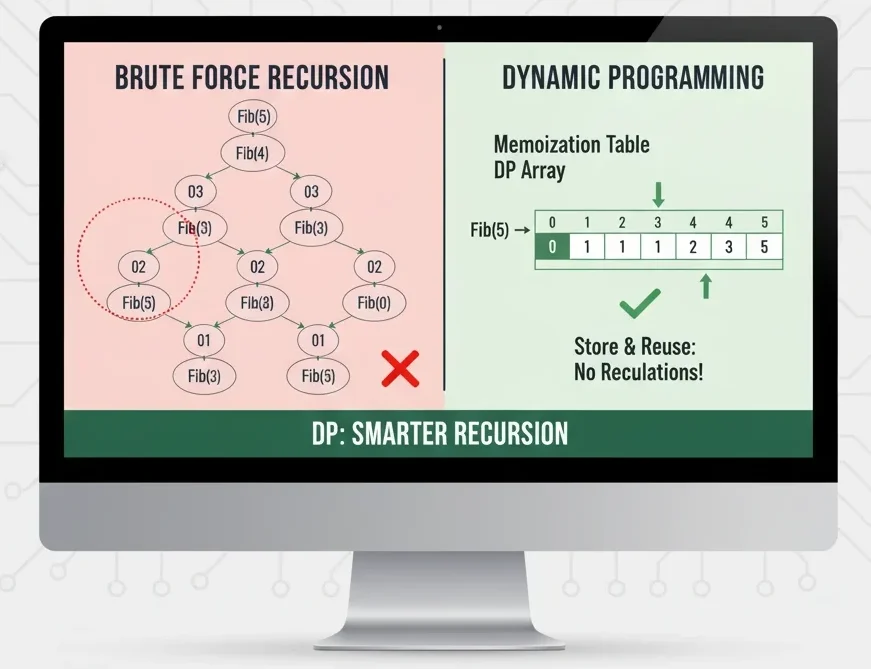
If you’ve ever sat with a Data Structures & Algorithms (DSA) – dynamic programming (DP) problem for hours, scratching your head, you’re not alone. Many students (including me, once upon a time) hear the word “DP” and think it’s some mystical topic that only experts can handle. But here’s the good news: DP isn’t magic. It’s just problem-solving with a little extra memory.
Let’s walk through it slowly, step by step, without throwing in heavy jargon.
What is Dynamic Programming, Really?
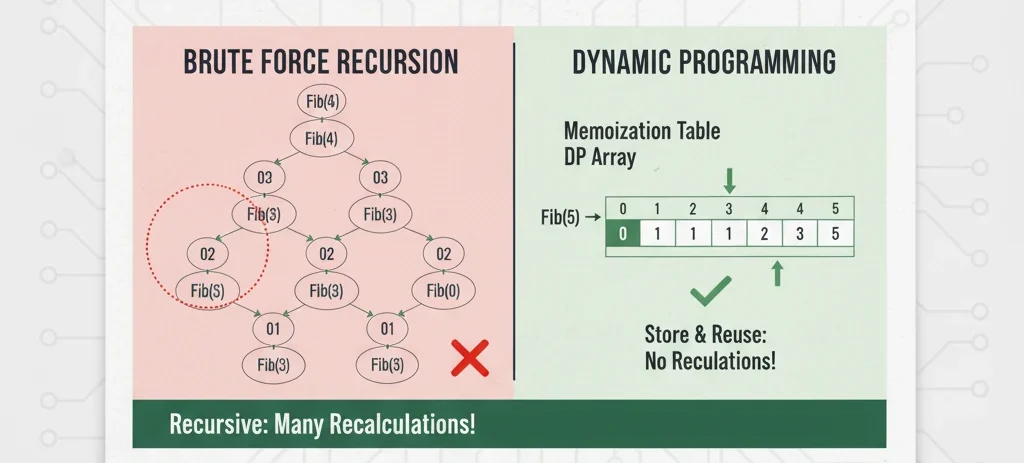
Dynamic Programming is nothing but a smarter way to solve problems where the same sub-problems keep repeating. Instead of solving them again and again, you store the answers and reuse them.
Think of it like this: imagine you’re preparing for an exam and you’ve already solved a tricky math problem once. If the same question comes again, will you redo the whole calculation? Of course not. You’ll check your notebook where you wrote the solution. That’s DP in a nutshell.
Step 1: Identify Overlapping Subproblems in Data Structures & Algorithms (DSA) – dynamic programming (DP)
The first step is spotting whether DP is even needed. Many problems don’t need it.
Take the Fibonacci series:
F(n) = F(n-1) + F(n-2)
If you write a plain recursive function, it will calculate the same Fibonacci numbers again and again. For example, while calculating F(5), it will separately compute F(3) multiple times. Waste of time, right?
That’s where DP saves the day. Store the results, and next time you need them, just look them up.
Step 2: Two Main Approaches in dynamic programming (DP)
There are two common DP styles:
- Top-Down (Memoization) – You write the recursive solution as usual but keep a dictionary/array to store results of solved sub-problems. Next time the function is called with the same input, it directly returns the stored value.
- Bottom-Up (Tabulation) – Instead of recursion, you start solving from the smallest sub-problems and build your way up. Usually done with loops and arrays.
For beginners, memoization feels easier because it looks similar to normal recursion. But as you practice, bottom-up often becomes faster and cleaner.
Step 3: Break Down with Examples in dynamic programming (DP)
Example 1: Fibonacci Numbers
- Naive recursion: exponential time.
- With DP (memoization): O(n).
Python Fibonacci Code
def fib(n, dp):
    if n <= 1:
        return n
    if dp[n] != -1:
        return dp[n]
    dp[n] = fib(n-1, dp) + fib(n-2, dp)
    return dp[n]

n = 10
dp = [-1] * (n+1)
print("fib(", n, ") =", fib(n, dp))
Run on Programiz
Example 2: The Classic “Knapsack Problem” in dynamic programming (DP)
You have a bag with limited weight capacity and items with given weights and values. The question: how do you maximize the value without exceeding capacity?
Here’s how DP helps:
- At every step, you decide: take the item or leave it.
- If you take it, reduce capacity and add its value.
- If you skip it, move on to the next item.
Without DP, this explodes into many repeated choices. With DP, you store results of (current_index, remaining_capacity) so you don’t redo them.
This example is why DP is loved in competitive programming and interviews.
Step 4: Recognize Common Patterns in dynamic programming (DP)
Most DP problems fall into certain patterns. Spotting them saves a lot of time. Some popular ones:
- Fibonacci-like problems – climbing stairs, tiling, etc.
- Knapsack-type – subset sums, partition problems.
- Grid-based DP – unique paths, minimum path sum.
- String DP – longest common subsequence, edit distance.
The trick is not to memorize solutions but to recognize which category a new problem belongs to.
Step 5: Practice Gradually in dynamic programming (DP)
Don’t jump directly into tough problems. Start small. A good roadmap:
- Fibonacci, climbing stairs, simple grid problems.
- Knapsack, coin change, partition problems.
- Longest common subsequence, edit distance.
- More advanced DP like matrix chain multiplication or DP on trees.
Every solved problem adds to your “pattern library.
Why Students Struggle with DP
- Overthinking: Many treat DP as a brand-new subject, instead of just an extension of recursion.
- Memorizing code: Doesn’t work. You need to understand why the states are stored.
- Fear of complexity: Yes, some DP problems look scary. But the easiest way to get better is to keep solving.
Final Thoughts
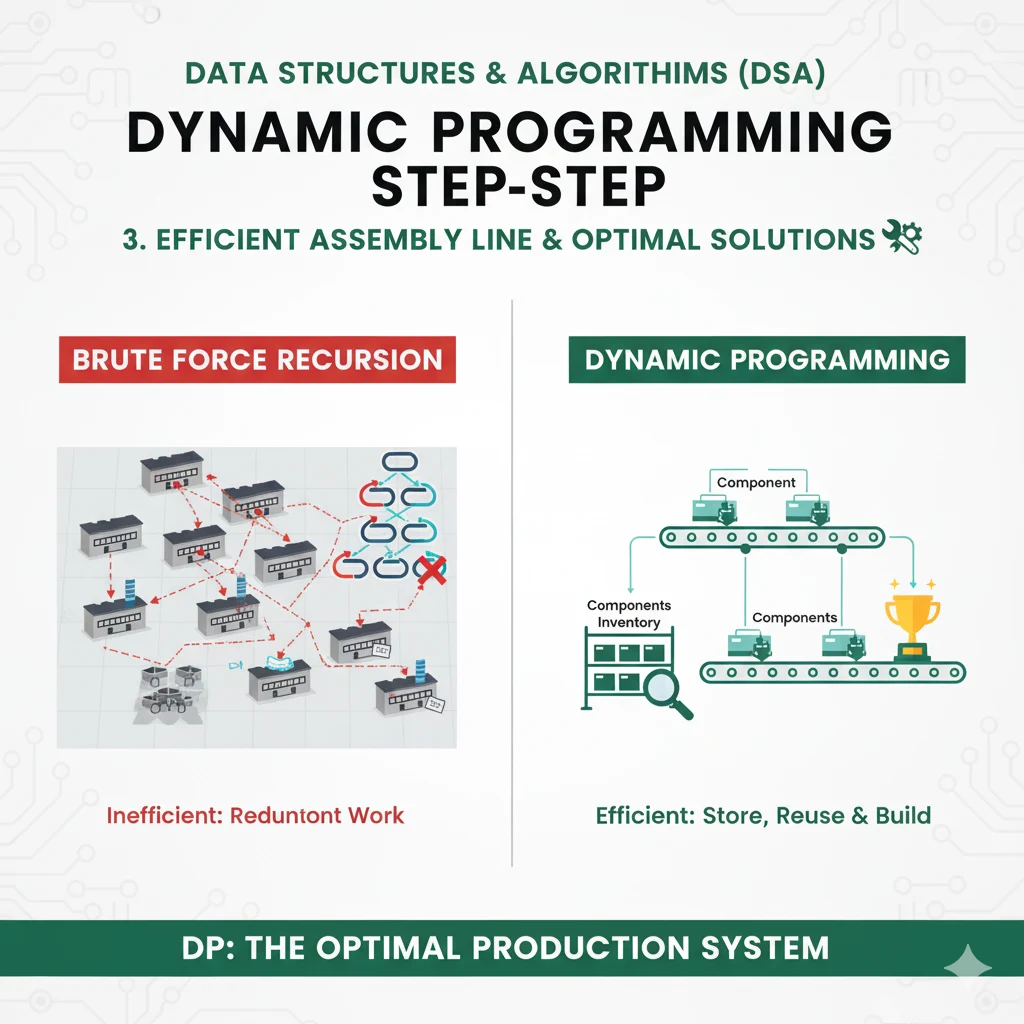
Dynamic Programming isn’t about learning fancy formulas. It’s about avoiding repeated work. That’s it.
Next time you see a problem, ask:
- Does it break into smaller subproblems?
- Do those subproblems repeat?
- Can I store and reuse results?
If yes, you’ve got yourself a DP problem. Start small, write code, make mistakes, debug, and improve. Over time, the patterns will click, and you’ll realize DP is not a monster but a powerful friend in problem-solving.
To strengthen your basics, don’t miss our complete guide on Analysis of Algorithm in Data Structure
Heard 123winclub’s where it’s at! Gotta check it out and see if the rumors are true. Join me! Click here: 123winclub
Yo! Been messing around on taisx66 lately and it’s not bad at all. Good variety of games and the site runs smoothly. Give it a shot taisx66.
Hey, check out 42betapp. Got myself a decent little win today. App’s easy to use and deposits were quick. I recommend it 42betapp.
What up peeps? Gave xn888 a whirl and I’m impressed man. Solid platform, good bonuses. Worth a punt if you ask me xn888.
Oh, you mean Bitcasino.io? Yeah, I’ve dabbled. Good crypto casino if you’re into that kinda thing. Smooth gameplay too, which is always a plus. Give it a spin here: bitcasino.io
Looking for a reliable Okbet redeem source? Seems like this site might have the hookup. Gonna give it a whirl! Check out okbet redeem code
Anyone using the fb777 app for Android? How’s the performance? Is it stable and easy to use? fb777 app for android
FlamengoBetano, E aí! The site is easy to navigate. I can switch between sports and games easily. A great feature to have!flamengobetano
Alright, trying out teenpattigold111. Looks promising. if you are into Teen Patti thing then this is for you! Jump in and start playing: teenpattigold111
Just tried Crasher Casino – pretty cool! Some fun games and it was surprisingly easy to get started. Definitely worth checking out if you’re looking for something new. Visit here: crashercasino
52winfun– yeah, it’s alright. Pretty standard setup, but hey, sometimes simple is good, right? Good place to kill some time 52winfun.
01win55 is okay if you are looking for a simple experience. Not the flashiest, but functional, solid, gets the job done01win55.
Downloaded some games from x7777gamedownload. Pretty smooth process, no issues. A good place to check out new options x7777gamedownload.